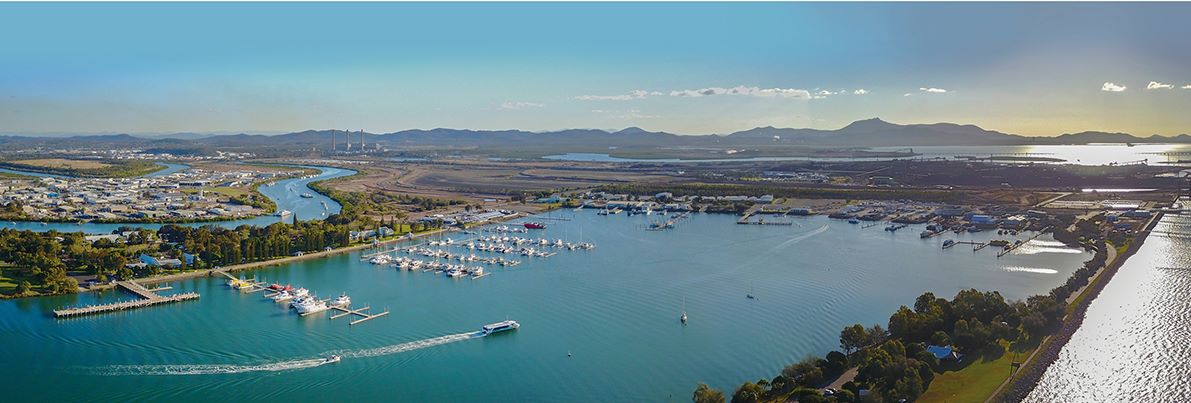
Every year, the Gladstone Harbour Report Card summarises the ‘health’ of the largest harbour in the Great Barrier Reef. Our new publication in Ecological Indicators outlines how we designed the underlying monitoring and reporting program, which includes social, cultural, economic and environmental dimensions of harbour health.
Why Gladstone?
When I joined the embryonic Gladstone Healthy Harbour Partnership in 2012 (it was formally launched the following year), the name of this port town in central Queensland was notorious with dredging, fish kills, a booming energy industry and soaring house prices.
Gladstone residents, and Australians in general, were concerned for the turtles, barramundi, dugong, mangroves, corals and the many other amazing species which live in the region. They wanted to know how the harbour system was faring, and how much more development could occur before the environment and lifestyle enjoyed by so many was undermined.
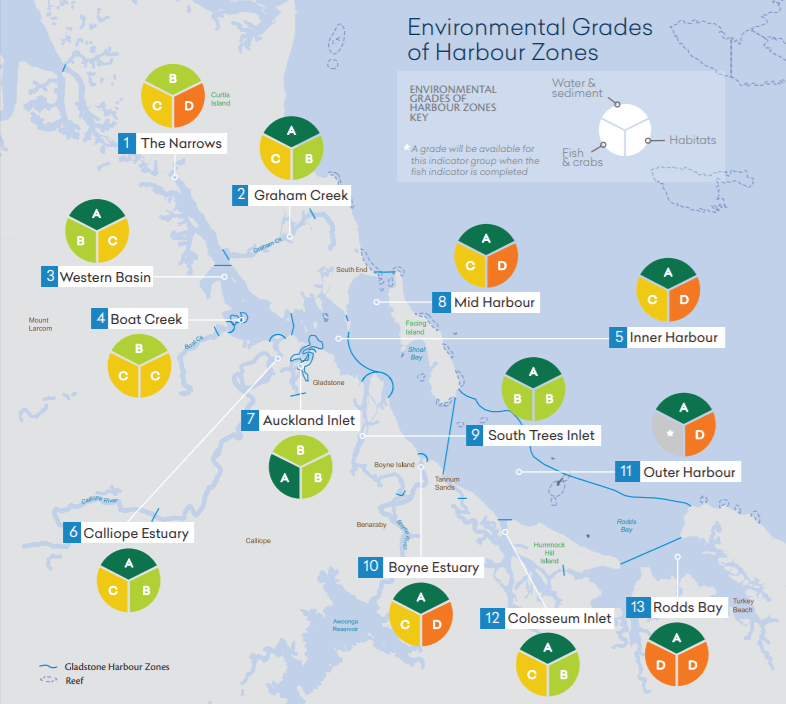
A whole-of-system approach to monitoring & reporting
Before we could even think about getting water sampling underway, we needed to understand what a healthy harbour meant to those responsible for managing it. Gladstone Harbour stakeholders from industry, community groups, government and research agencies came together for a series of workshops and agreed on a vision – that ‘Gladstone has a healthy, accessible, working harbour’.
Our Independent Science Panel then set out to translate this, and a series of statements relating to different aspects of a healthy harbour, into an annual monitoring and reporting program. The program is now well under way (the 2018 report card results shown here are from the fourth report card) and the report card is accompanied by citizen science programs, childrens books, stewardship metrics and a wide range of engagement activities.
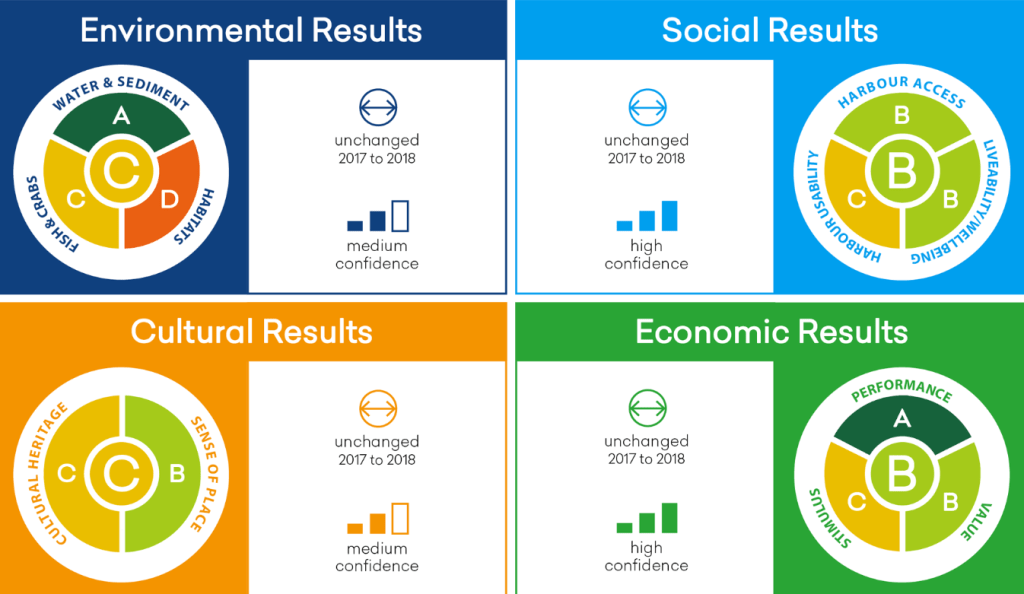
10 core ingredients for ecosystem health report cards
Our aim with this paper was to share the lessons we learnt during the program design stage, according to ten principles associated with report card development (based on research by Rod Connolly and colleagues):
- Strong links to all stakeholders at all stages
- Rigorous science
- Effective communication
- Setting clear goals (led by stakeholders, refined by scientists)
- Realistic expectations about timelines and what can be delivered
- Flexibility in implementation to changing circumstances
- Transparency, open access and accountability
- Results linked to actionable management recommendations
- Regular evaluation of methods, trends and impact
- Long term commitment and adequate resourcing
Publishing applied research is not easy!
This paper has taken 5 years to draft, redraft, submit, revise, resubmit, revise again… and eventually see through to publication. The ten principles above are hardly revolutionary yet this paper is one of very few case studies in the academic literature about the process of designing an environmental report card.
We hope it is helpful to others, and in keeping with the values of the Partnership, it has been published open access to that it is easily accessible for others trying to weigh up baselines vs targets, numerical scores vs letter grades or all the other fun and games involved in designing a report card!

Thank yous
It is wonderful to be able to share the hard work of so many over the years. Special thanks to my coauthors Ian, John, Pinto, Madeleine and John, our brilliant colleagues Lyndal, Crystal, Mark, Rachael, Kirstin and Lucy, our Management Committee and Chair Paul and of course the other Independent Science Panel members involved in the ‘early years’: Eva, Richard, Rob, Cathy, Jenny, Michele, Frans, Susan and Britta.
Above all, we thank Gladstone Healthy Harbour Partnership members for their ongoing support and skepticism, their interest and their reality checks. This is just the start after all!
Citation
McIntosh, E.J., Rolfe, J., Pinto, U., Kirkwood, J., Greenlee, J., Poiner, I.R. (2019). Designing report cards for aquatic health with a whole-of-system approach: Gladstone Harbour in the Great Barrier Reef. Ecological Indicators, 102: 623-632. [open access thanks to Central Queensland University]
Lyndon Llewellyn will be presenting a related paper ‘Gladstone Harbour: a case study of building social license-to-operate in a multi-use area’ at the APPEA 2019 Conference and Exhibition in May.
 Dr Emma J McIntosh
You must be logged in to post a comment.