Amy Whitehead and colleagues from the University of Melbourne have recently published an article about the application of systematic conservation planning in conjunction with a major urban planning project.
By working with planning agency staff, conservation planning information was directly integrated into decisions about what to mark for future clearance and protection. Calls have been made for the incorporation of conservation planning into urban planning for many years and it is exciting to see such a striking example of how it can work.
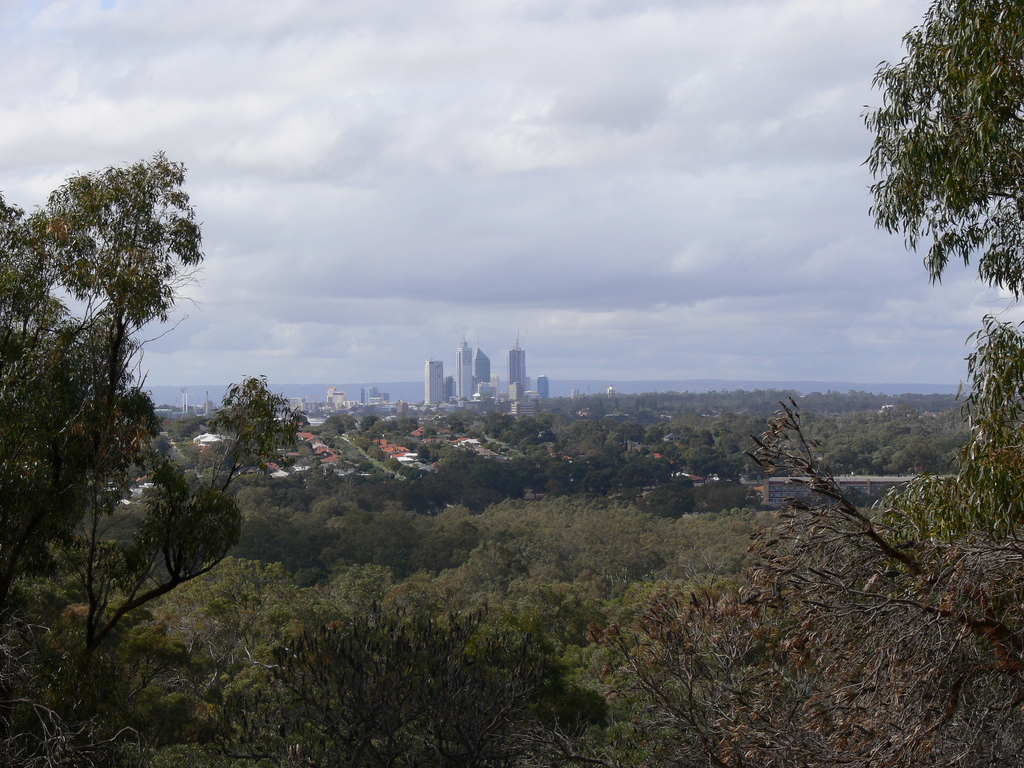
Using planning systems to avoid the death of our native habitats by a thousand cuts seems obvious. The title image of Perth city above, taken by FCB Excalibur (CC BY-SA 2.0) highlights how lucky many Australians are – our cities are surrounded by stunning bushland and incredible parrots, possums and plants come right into our backyards.
By deciding which areas require special protection, or are in fact less of a problem to develop on, before authorising any development improves outcomes for developers and our natural environment. Particularly compared with the bulldoze first, apologise later approach still common in parts.
This is what initially attracted me to study systematic conservation planning for my PhD – it makes so much more sense to avoid losses than try to fix problems after they have occurred (which is usually more expensive, with a lower likelihood of success).
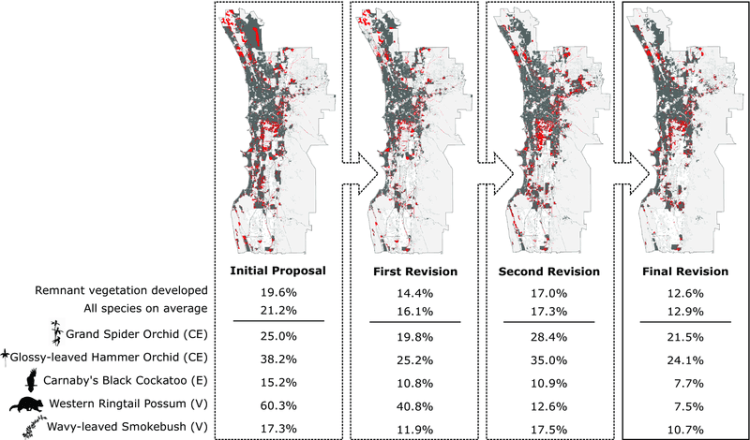
Now, developers in Perth will have clearer direction about where to build to avoid conflicts with environmental values, and protected areas can be established where they are most needed for vulnerable species and habitats, rather than on whatever undeveloped or uncultivated land is left behind.
A key point the authors make in their article is the necessity of “concerted and consistent engagement between researchers and planners throughout the project”, involving over 40 meetings, seminars and similar. These kinds of collaborations require work and it’s fantastic to see the authors were able to find the time to build those relationships as well as to share their experience through this publication.
But one word of caution… the authors claim this exercise has been successful and achieved biodiversity impact by reducing losses. While this is an excellent initiative, it is too early to sit back and claim success.
True impacts for biodiversity will only be able to be measured in the future, after this plan has come into effect. Only then will we will find out whether the plan is complied with, and whether the lost habitat and reduction in population sizes matches, rather than exceeds the percentages expected.
After all, planning can only ever provide a prediction of impact. I hope to see future studies dedicated to confirming whether this plan has resulted in the expected security of our wonderful bushland and unique species.
See the full article: Whitehead AL, Kujala H, Wintle BA. 2016. Dealing with cumulative biodiversity impacts in strategic environmental assessment: a new frontier for conservation planning. Conserv. Lett. 10:195–204
 Dr Emma J McIntosh
You must be logged in to post a comment.