At our lab meeting today the topic was the research viva – how to prepare for it, what to expect and how to defend your work when challenged.
Although all of our lab members are at different stages of our DPhils (PhDs), the viva process is on all of our minds. Variations on the examiner meeting or viva come up several times during our candidacy at Oxford. Each time there are at least two examiners and the final ‘examination’ is a private meeting – rather than give a presentation, you have a discussion and answer questions about your work.
Before our lab meeting I looked up some resources online and found these:
- Useful, general considerations from Vitae, a research skills website.
- Academic martial arts: Defending your PhD by @mattmight – which sounded pretty entertaining, but also had some useful advice e.g. that a proper defense begins at the thesis proposal.
- Patricia Gosling and Bart Noordam recommended you ‘respect the formalities’ in their pointers for defending your thesis with flair. In Oxford that means wearing your sub fusc properly, but we can go into that another time…
- What to do when you don’t know the answer was addressed nicely by James Hayton, author of PhD: An uncommon guide to research, writing & PhD life.
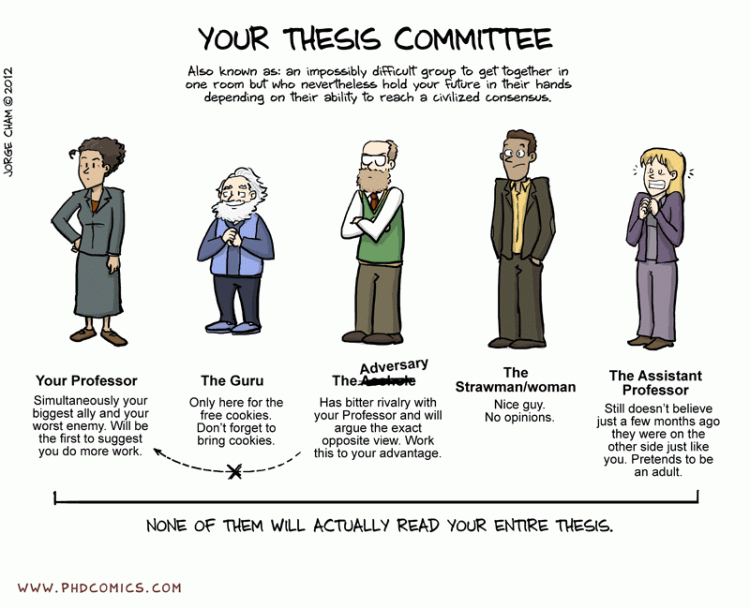
- Finally, the PhDComics cartoons in Ryan Raver’s article illustrated his top 10 tips in all the best possible ways!
While these were all great resources, it became clear that members of our group were keen to find out more about procedural details or specific scenarios, the latter of which differ hugely between vivas.
After a very useful discussion, we came away with some valuable take home messages:
- Don’t make the viva into a bigger issue than it needs to be – you will be nervous, it will be uncomfortable, but ultimately, you had the tools to get you into it, so you have the tools to get you out of it.
- Most examiners want to pass you and want to see you succeed in your work.
- Choosing your examiners carefully, and advisedly, can be very important.
There are two things that every doctoral examiner wants to get out of a viva:
- proof of intellectual ownership – confidence that the student has done the work they said they did;
- proof of intellectual command – assurance that they understand what they have done;
- and a third, optional, nice-to-have, would be a creative conversation about the research and what the student will go on to do next.
We also learnt a few strange, and slightly less useful facts, like:
- If there wasn’t a notice on the door of your college while the examination took place, it didn’t happen… (I’m sure it’s not quite that dire, but it’s archaic all the same!)
So now it’s time to put any fears about the viva aside and get on with actually finishing the thesis…!
 Dr Emma J McIntosh
You must be logged in to post a comment.